
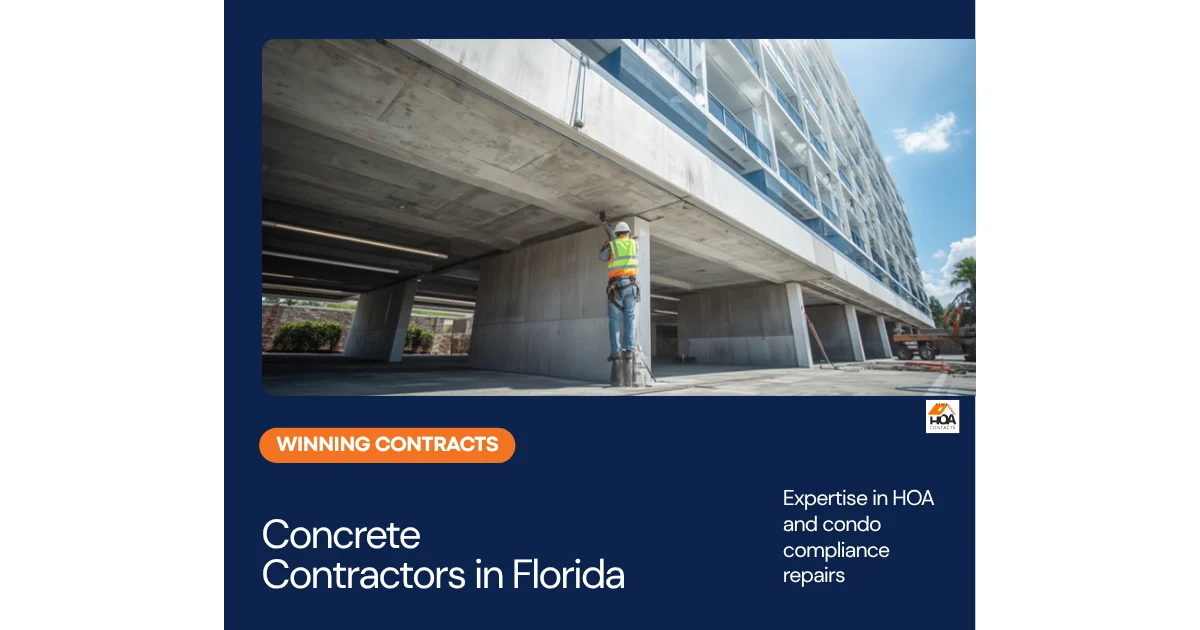

Florida’s condo buildings and HOA communities sit on concrete — foundations, parking structures, walkways, pool decks, and balconies that deteriorate from salt air, water intrusion, and carbonation. For concrete contractors, HOA and condo contracts represent large-scale restoration projects that generate significant revenue and lead to ongoing maintenance relationships. Moreover, Florida’s milestone inspection law has exposed structural concrete deficiencies across thousands of buildings, creating a surge of mandatory repair work. Winning concrete HOA condo contracts starts with reaching the boards who approve these critical projects. This process mirrors what we outline in our guide to winning HOA and condo contracts in Florida.
Why Concrete HOA Condo Contracts Keep Florida Contractors Busy Year-Round
Concrete deterioration in Florida is not a matter of if but when. In fact, chloride intrusion from salt air corrodes rebar, carbonation weakens the concrete matrix, and water infiltration accelerates both processes. Consequently, every condo building older than 25 years faces some degree of concrete restoration need.
Additionally, the Surfside collapse and resulting legislation have made structural concrete repair a top priority for boards and legislators alike. As a result, condo associations are fast-tracking engineering inspections and budgeting for restoration work that can no longer be deferred. Furthermore, insurance carriers now scrutinize structural maintenance records when underwriting condo policies.
Where the Concrete Work Is in HOA and Condo Communities
Community concrete restoration covers critical building systems. Specifically, common opportunities include:
- Balcony and walkway concrete restoration
- Parking garage structural repair and coating
- Spalling and delamination repair
- Rebar exposure and cathodic protection
- Sidewalk and curb replacement
- Pool deck resurfacing and leveling
- Foundation crack repair and underpinning
- Seawall and retaining wall restoration
In particular, parking garage restoration represents the highest-value concrete work in the condo market. Indeed, a multi-level garage restoration can span years and generate contracts worth millions. Of course, even smaller projects like balcony spalling repair and sidewalk replacement produce strong revenue for concrete contractors.
How to Reach the Boards Who Approve Concrete Projects
Concrete restoration projects typically require board approval, engineering oversight, and reserve fund allocation. Therefore, your outreach must target both board members and the engineers who advise them. Importantly, boards that have recently received milestone inspection reports identifying structural deficiencies are your highest-priority prospects.
Moreover, many boards are overwhelmed by the scope and cost of required repairs. Consequently, contractors who can clearly explain the work, prioritize critical areas, and offer phased approaches earn board confidence. HOA Contact Lists provides verified board member contacts so you can reach these decision-makers directly.
Positioning Your Concrete Company for Community Contracts
Boards want concrete contractors who understand structural restoration, not just cosmetic repairs. Specifically, emphasize your experience with post-tension systems, rebar rehabilitation, and cathodic protection. Furthermore, demonstrating a track record of working alongside structural engineers builds credibility with boards and their consultants.
Additionally, providing detailed photo documentation of similar projects helps boards understand your capabilities. As a result, they can justify the investment to unit owners who must approve special assessments. Ultimately, the concrete contractor who educates the board and simplifies a complex process wins the project.
Understanding Post-Tension Cable Systems in Florida Condos
Many Florida high-rise condos built from the 1970s through the 1990s use post-tension concrete slabs, where steel cables running through the concrete are tensioned to add strength and allow for thinner, longer spans than conventional reinforced concrete. This construction method creates a specific restoration challenge: repairing spalling or corrosion near a post-tension cable requires specialized knowledge, since cutting into concrete without first locating and de-stressing the cables can be dangerous and cause additional structural damage.
Concrete contractors who can demonstrate certified post-tension repair experience have a significant advantage when bidding on older high-rise buildings, since boards and their engineers are increasingly aware of this risk following high-profile structural failures. Investing in cable-locating equipment and training, and being able to speak confidently about your post-tension repair protocol during a board presentation, differentiates you from general concrete contractors who may not have the specialized experience these buildings require.
Start Winning Concrete HOA Condo Contracts Today
Florida’s aging condo inventory and mandatory inspection requirements guarantee growing demand for concrete restoration. Therefore, contractors who reach boards early with credible proposals win these high-value projects. Search verified HOA contacts and connect with the boards investing in structural safety.
Frequently Asked Questions
What concrete work do Florida condo communities need?
Condos need balcony restoration, parking garage repair, spalling and rebar repair, sidewalk replacement, pool deck resurfacing, and seawall restoration. Additionally, milestone inspections frequently reveal deferred structural concrete needs.
How do you win a condo concrete restoration contract?
Reach board members and engineers with proposals demonstrating structural expertise, phased cost management, and similar project experience. HOA Contact Lists connects you with the boards making these critical investments.
What is post-tension concrete and why does it matter for repairs?
Post-tension concrete uses tensioned steel cables to strengthen slabs, common in Florida high-rises built from the 1970s-1990s. Repairing spalling near these cables requires specialized locating and de-stressing knowledge to avoid dangerous or damaging mistakes.
Why has structural concrete work increased in Florida since 2021?
Following the Surfside collapse, Florida strengthened milestone inspection and structural reserve requirements, which has surfaced deferred concrete deterioration in thousands of buildings that boards can no longer defer funding for.
Do concrete contractors need to work with structural engineers on these projects?
Yes, in most cases. Boards typically rely on an engineer’s assessment to define the scope and prioritize repairs, so demonstrating a track record of collaborating with engineering firms builds credibility during the bidding process.
The Milestone Inspection Pipeline for Concrete Contractors
Florida’s milestone inspection program has created an unprecedented backlog of concrete restoration work across the state. Buildings that are 25 years old in coastal areas and 30 years old elsewhere must complete phase one visual inspections, and many are failing. Phase two inspections requiring destructive testing are revealing extensive spalling, corrosion, and structural deficiencies in balconies, walkways, parking decks, and support columns. The structural integrity reserve studies now required by law mean that boards must fully fund these repairs rather than using special assessments or deferring maintenance. For concrete contractors with the right certifications and engineering partnerships, this regulatory change represents a decade-long pipeline of high-value restoration projects.
Related Articles
- What Florida’s Milestone Inspection Law Means for Contractors
- How Waterproofing Contractors Win Condo Contracts
- How Fence Contractors Win Florida HOA Contracts
- What HOA Reserve Studies Mean for Contractors
Ready to reach Florida HOA board members directly? Search the Florida HOA database — 209,000+ verified contacts, searchable by county, city, or ZIP code.